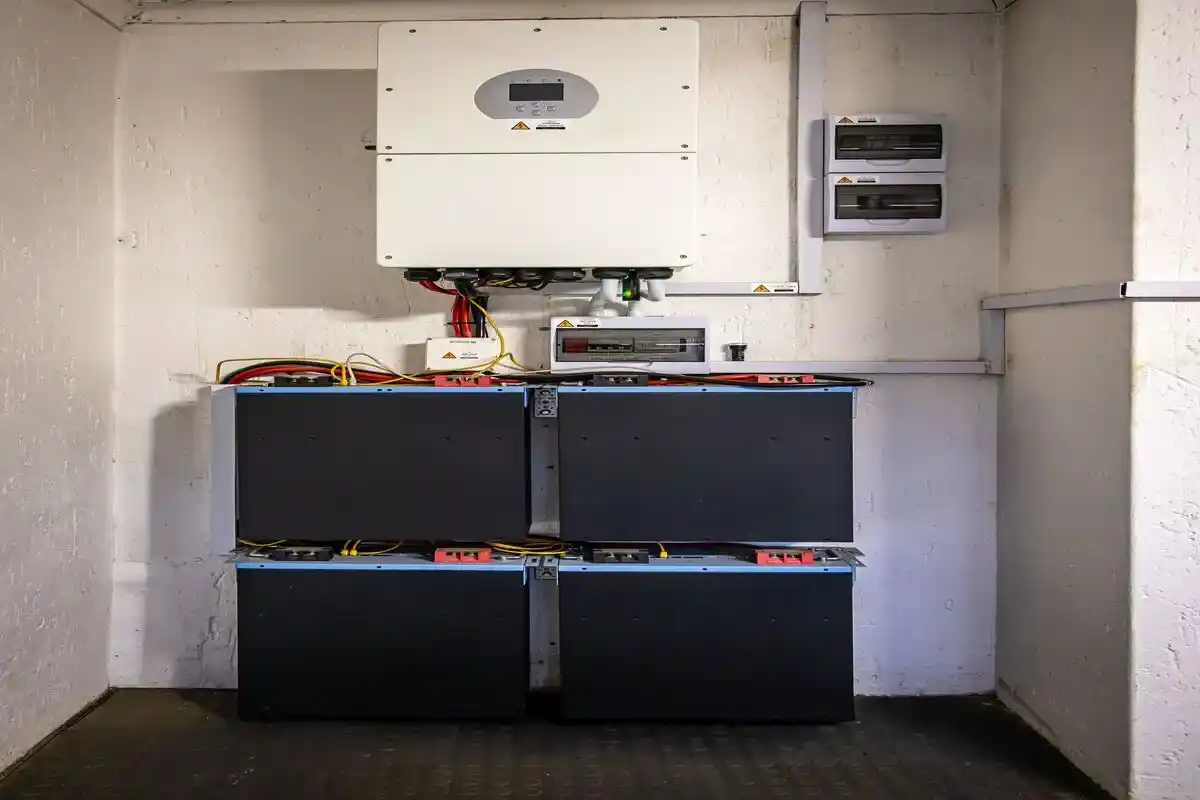
A 10 kWh lead-acid battery bank costs nearly half as much upfront as a lithium setup, leading many homeowners to think they landed a bargain. That initial discount disappears the first time a grid outage demands heavy split-phase loads, draining the bank faster than expected while cutting its lifespan in half.
Lead-acid and Lithium Iron Phosphate (LiFePO4) store power using fundamentally different chemistries. In a residential backup system, evaluating batteries simply by their nameplate sticker price guarantees you will pay double down the road.
Understanding usable energy, rate-dependent capacity losses, and thermal limitations reveals which chemistry actually protects your home without draining your wallet.
Technical Performance Breakdown: Chemistry in the Real World
Usable Depth of Discharge (DoD)
Lead-acid batteries—whether flooded or sealed AGM—suffer rapid degradation if discharged beyond 50% of their total capacity. Discharging an AGM bank down to 20% on a cold winter night drops its usable lifespan from roughly 500 cycles to fewer than 150 cycles.
LiFePO4 chemistry easily delivers a continuous 80% to 90% Depth of Discharge without stressing internal cell structures. That means a 10 kWh lithium bank gives you 8.5 to 9.0 kWh of actual energy, whereas an equivalent 10 kWh lead-acid bank safely yields only 5.0 kWh before requiring an immediate recharge.
Peukert’s Law and Inrush Currents
Lead-acid capacity shrinks drastically as the discharge rate climbs, an electro-chemical reality governed by Peukert’s Law. Drawing a heavy 3,000W to 5,000W load to start a well pump or run a refrigerator compressor pulls down the effective Amp-hour rating of an AGM battery by 20% to 35%.
LiFePO4 features a flat discharge curve with near-zero internal resistance. The battery delivers full rated capacity whether powering a 5W LED bulb or handling a sustained 100A draw through a 48V hybrid inverter. (If you are designing a full backup system, check our in-depth formula on how to size a 48V LiFePO4 battery bank for home backup).
Round-Trip Efficiency & Charging Drag
Lead-acid chemistry tops out at an inefficient 75% to 80% round-trip coulombic efficiency. Because 20% or more of your charging energy is lost as heat, keeping them float-charged burns extra grid power or wastes solar production.
LiFePO4 operates at 95% to 98% round-trip efficiency, absorbing charging current rapidly right up to 99% State of Charge (SoC). Lead-acid banks require hours of slow “absorption” charging to reach full capacity, leaving you vulnerable if a second grid blackout hits shortly after the first.
Head-to-Head Comparison: The Lifetime Cost Reality
The numbers below assume standard US retail pricing for reliable residential-grade hardware: quality 12V 200Ah AGM batteries ($350 each) versus an industry-standard 48V 100Ah server rack LiFePO4 module ($1,250 each).
| Technical Metric | Lead-Acid (AGM Deep Cycle) | Lithium Iron Phosphate (LiFePO4) |
|---|---|---|
| Rated Nameplate Capacity | 10 kWh | 10.24 kWh (Two 5.12 kWh modules) |
| Usable Depth of Discharge (DoD) | 50% (Max safe discharge) | 85% – 90% (Standard operating window) |
| Usable Energy per Single Cycle | 5.0 kWh | 8.7 kWh – 9.2 kWh |
| Cycle Life to 80% Capacity | 400 – 600 cycles | 4,000 – 6,000 cycles |
| Peukert’s Effect Loss Under Load | High (20% – 35% loss at 0.5C draw) | Negligible (<2% loss at 0.5C draw) |
| Round-Trip Efficiency | 75% – 80% | 95% – 98% |
| Total Lifetime Usable Energy | ~2,500 kWh (5 kWh × 500 cycles) | ~39,000 kWh (8.7 kWh × 4,500 cycles) |
| Initial Upfront Hardware Cost | ~$1,400 (Four 12V 200Ah AGMs) | ~$2,500 (Two 48V 100Ah modules) |
| Real Cost per Usable Lifetime kWh | ~$0.56 / kWh | ~$0.064 / kWh |
10-Year Ownership Scenario: AGM vs. 48V Server Rack LiFePO4
Consider an average US home running a dedicated emergency subpanel for 120V essentials during outages and storm seasons.
Option A: Four 12V 200Ah AGM Batteries in Series (48V 9.6 kWh Nominal)
- Usable Daily Capacity: 4.8 kWh at 50% DoD.
- Replacement Cycle: Every 3 to 4 years due to chemical aging, sulfation, and periodic deep discharges during extended winter outages.
- 10-Year Hardware Cost: 3 complete battery sets purchased ($1,400 × 3 = $4,200).
- Added Expenses: Higher standby float charging electricity costs, replacement heavy-gauge interconnect cables, and multiple disposal/core-exchange trips.
Option B: One 48V 100Ah LiFePO4 Server Rack Battery (5.12 kWh Nominal)
- Usable Daily Capacity: 4.35 kWh at 85% DoD (matching the real-world output of the lead-acid bank).
- Replacement Cycle: None required within 10 years; typical cell degradation drops capacity to ~80% after 12 to 15 years of daily cycling.
- 10-Year Hardware Cost: $1,250 single upfront investment.
- Added Expenses: Zero maintenance hardware, plug-and-play expansion slots in standard 19-inch racks, and integrated Battery Management System (BMS) communications.
Choosing LiFePO4 cuts overall 10-year battery expenditures by nearly 70% while requiring a third of the physical footprint and weight.
Maintenance and Physical Installation Realities
Lead-Acid: Weight, Ventilation, and Sulfation
A standard 12V 200Ah deep-cycle AGM battery weighs roughly 130 pounds, meaning a 48V string totals over 520 pounds on your floor framing. Flooded variations require regular distilled water top-offs and mechanical ventilation per NEC 480.9 to vent explosive hydrogen gas generated during equalization charges.
Lead-acid battery terminals also suffer from galvanic corrosion, which creates high-resistance joints that overheat under sustained loads. If left below 100% state of charge for more than a few days, lead sulfate crystals permanently harden on the plates, causing irreversible capacity loss.
LiFePO4: Solid Reliability with Low-Temp Limits
A 48V 100Ah LiFePO4 server rack battery weighs approximately 100 pounds, packing the same usable punch as 500+ pounds of lead. LiFePO4 chemistries do not off-gas toxic or combustible fumes during charge-discharge cycles, allowing safe installation inside utility closets or basements.
The primary operational constraint with LiFePO4 is ambient cold. Charging lithium iron phosphate below 32°F (0°C) causes permanent lithium plating on the cell anodes, creating an internal short hazard. Ensure your battery module features an integrated BMS with automatic low-temperature charge cut-off protection, or install internal self-heating pads if mounted in an unheated garage.
Common DIY Mistakes & Safety Precautions (NEC Guidelines)
- Inadequate DC Disconnect Switches (NEC Article 706): Do not rely on an inverter’s internal digital power switch to de-energize the DC bus. Install an external, lockable, DC-rated disconnect switch or a high-ampere DC circuit breaker rated for at least 60VDC within sight of the battery system. AC disconnect switches cannot reliably break DC electrical arcs and will burn their internal contacts open.
- Skipping Class T Fuse Protection (NEC 240.21): Because LiFePO4 batteries have ultra-low internal resistance, an accidental dead-short can generate an instant fault current above 20,000 Amperes. Standard automotive fuses will arc internally and disintegrate. Always mount a Class T fuse with a minimum 20,000A to 100,000A Interrupting Rating (AIC) within 12 inches of the ungrounded positive battery terminal.
- Mixing Old and New Batteries in Parallel: Never connect fresh batteries in parallel with worn-out modules, regardless of chemistry. Differences in internal resistance force the newer, healthier battery to carry the bulk of charging and discharging currents, triggering premature failure.
Practical Takeaway: Terminal Torque and Pre-Charge
Torque your battery terminal connections using an insulated torque wrench set to the manufacturer’s exact specifications (typically 70 to 88 inch-pounds for M8 hardware). A loose connection will develop resistance, generate heat, and melt the terminal post long before your main fuse trips.
When connecting a 48V LiFePO4 bank to an inverter for the first time, never slam the main breaker closed on uncharged internal capacitors. Use a 50-ohm, 50W pre-charge resistor held across the switch terminals for 5 to 10 seconds to gently charge the inverter capacitors, preventing massive contact arcing and protecting your battery BMS from nuisance overcurrent trips.