Investing thousands of dollars in a residential battery storage system without first conducting an aggressive electrical audit is the most expensive mistake a homeowner can make. If you simply aggregate the average monthly kilowatt-hours (kWh) reported on your utility bill, you will either vastly oversize your battery bank—wasting capital—or undersize your inverter, causing it to fault the moment an inductive motor kicks on during an emergency.
A resilient home backup system relies not on powering your entire house indefinitely, but on isolating essential circuits and eliminating parasitic phantom draws. Here is how to execute a professional-grade DIY energy audit to accurately size your inverter capacity and battery storage reserve.
Continuous vs Surge Watts: Why Appliance Nameplates Lie
Every home appliance draws power in two distinct operational modes: running (continuous) watts and starting (surge/inrush) watts. Resistive appliances (like baseboard heaters, toasters, and incandescent lights) draw an identical amount of power from startup to shutdown. Inductive loads (appliances powered by compressors and electric motors) require a massive pulse of energy to break mechanical inertia.
An average modern refrigerator may only consume 150W to 200W while cooling, but its compressor startup creates an inrush draw of 1,200W to 1,800W lasting 200 to 500 milliseconds. If your hybrid inverter’s surge ceiling cannot handle that sudden inductive spike while powering existing baseline loads, the entire system will trip on an overcurrent fault.
Common Household Appliances: Continuous vs Surge Profile
| Appliance | Running Power (Watts) | Surge / Inrush Power (Watts) | Operating Duty Cycle / 24h |
|---|---|---|---|
| Energy Star Refrigerator / Freezer | 150W – 250W | 1,200W – 1,800W | 8 – 10 hours intermittent |
| Submersible Well Pump (1/2 HP, 240V) | 800W – 1,050W | 3,000W – 4,200W | 1 – 2 hours total run time |
| Sump Pump (1/3 HP) | 600W – 800W | 1,800W – 2,400W | Intermittent (Storm dependent) |
| Gas Furnace Blower Motor | 400W – 650W | 1,200W – 1,500W | 4 – 8 hours during winter |
| Starlink Satellite Terminal & Router | 45W – 75W | 100W (Boot & Snow Melt) | 24 hours continuous |
| Medical CPAP Machine (Without Humidifier) | 30W – 50W | 60W | 8 hours overnight |
Eliminating Vampire Loads: The Hidden Battery Killer
Vampire loads (or phantom loads) represent the standby electricity consumed by modern electronics while turned “off.” Televisions, microwave clocks, smart plugs, cable boxes, and device charging transformers silently consume energy 24 hours a day, 365 days a year.
According to research from the U.S. Department of Energy (DOE), standby power accounts for 5% to 10% of residential energy use, translating to an average baseline leakage of 100W to 200W continuous per household.
In a utility-tied scenario, 150W of phantom load costs roughly $15 to $25 per month. In an off-grid battery backup scenario, however, that same 150W drain consumes 3,600 Watt-hours (3.6 kWh) of storage every single day. In our detailed calculation guide on how to size a 48V LiFePO4 battery bank, we demonstrated that an extra 3.6 kWh requirement forces you to purchase nearly an entire additional 5.12 kWh server rack battery module just to service idle electronics.
How to Audit and Kill Standby Draw:
- Deploy a Digital Plug-In Power Meter: Use an inline wattage monitor (such as a Kill-A-Watt) on individual electronics to measure real-time consumption over a 24-hour cycle.
- Smart Power Strips: Install master-controlled power strips for entertainment centers and home offices to cut phantom line voltage entirely when primary equipment powers down.
- Inverter Power-Save Search Mode: Ensure your hybrid inverter’s auto-sensing sleep mode is configured so it does not draw its full 40W to 80W internal tare loss when household loads drop below 15W.
Designing a Critical Load Subpanel (NEC Article 220 & 702)
Unless you install a commercial-scale 30 kWh to 50 kWh battery storage bank, backing up an entire 200-amp main residential service panel is financially and practically unviable. Central air conditioners, electric ranges, clothes dryers, and level-2 EV chargers will deplete an off-grid lithium storage pack in a matter of hours.
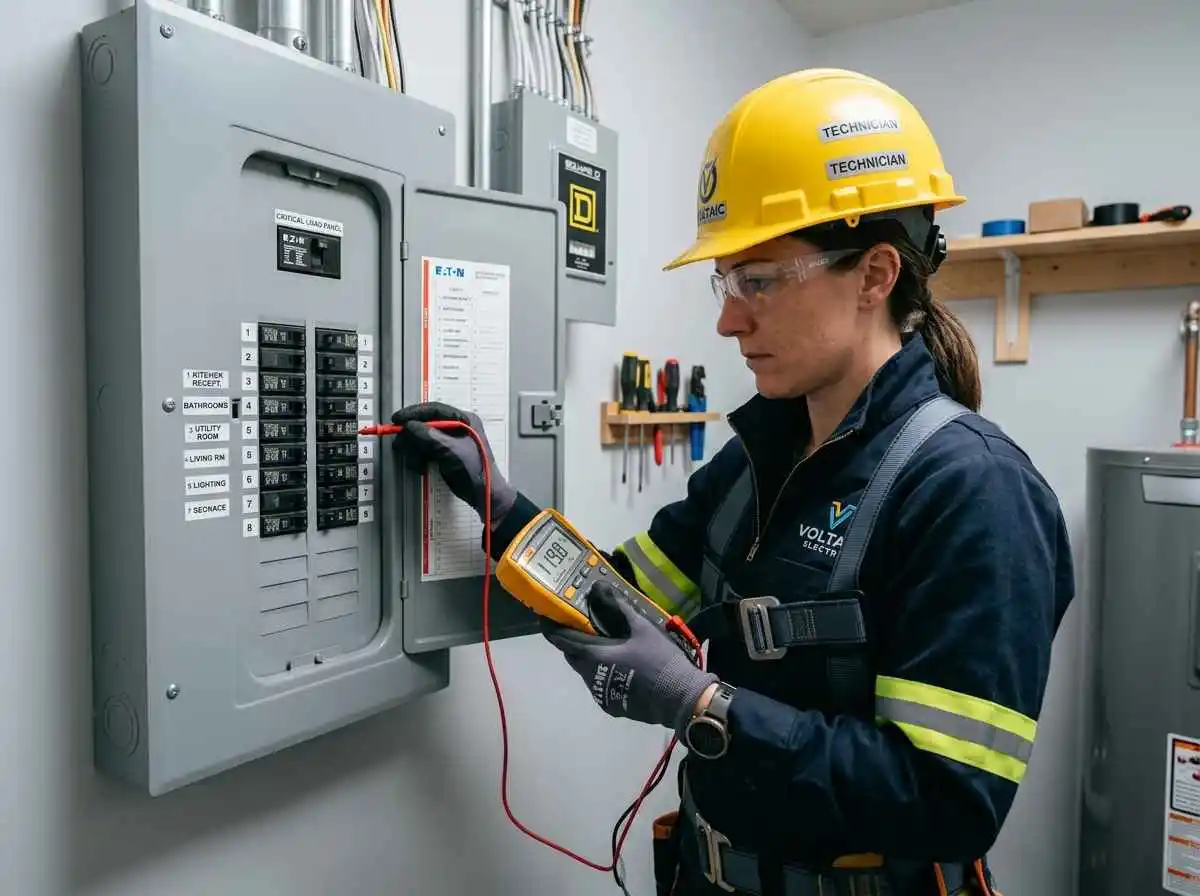
The standard engineering solution is installing a Dedicated Critical Load Subpanel (60A to 100A rating) positioned downstream of an automatic transfer switch (ATS) or manual transfer lock-out mechanism, compliant with NEC Article 702 (Optional Standby Systems).
- Identify Non-Negotiable Circuits: Limit the subpanel to refrigeration, home communications/networking, well pump or sump pump, gas furnace control circuits, and selected kitchen/medical lighting circuits.
- Balance the 120V Legs: Hybrid inverters provide split-phase 120V/240V AC power. Distribute heavy 120V household loads evenly across Line 1 (L1) and Line 2 (L2) busbars to avoid thermal imbalance and inverter transformer saturation.
- Coordinate Solar Input: Ensure that your critical daytime load profile matches the generation curve of your photovoltaic array. As outlined in our guide on DIY solar panel wiring (series vs parallel), matching peak production hours with battery recharge cycles guarantees that storage banks enter the evening at 100% state of charge.
The Step-by-Step Daily Energy Audit Formula
To finalize your daily backup requirement before purchasing hardware, run your critical appliances through the following formula:
Total Daily Wh = Σ (Appliance Running Watts × Daily Operating Hours) + Inverter 24h Tare LossExample Minimum Emergency Scenario:
- Refrigerator: 180W × 9 hours = 1,620 Wh
- Internet Router / Starlink: 60W × 24 hours = 1,440 Wh
- LED Lighting & Device Charging: 80W × 5 hours = 400 Wh
- Gas Furnace Fan (Winter): 500W × 4 hours = 2,000 Wh
- Inverter Internal Tare Draw: 50W × 24 hours = 1,200 Wh
- Calculated Total Daily Requirement: 6,660 Wh (6.66 kWh)
By applying energy efficiency practices and stripping away non-essential circuits, a compact 10 kWh to 15 kWh battery system can reliably power your home indefinitely through severe winter storms and extended grid blackouts.
3 thoughts on “Whole-Home Energy Audit for Battery Sizing: Vampire Loads, Surge Watts, and Critical Load Subpanels”