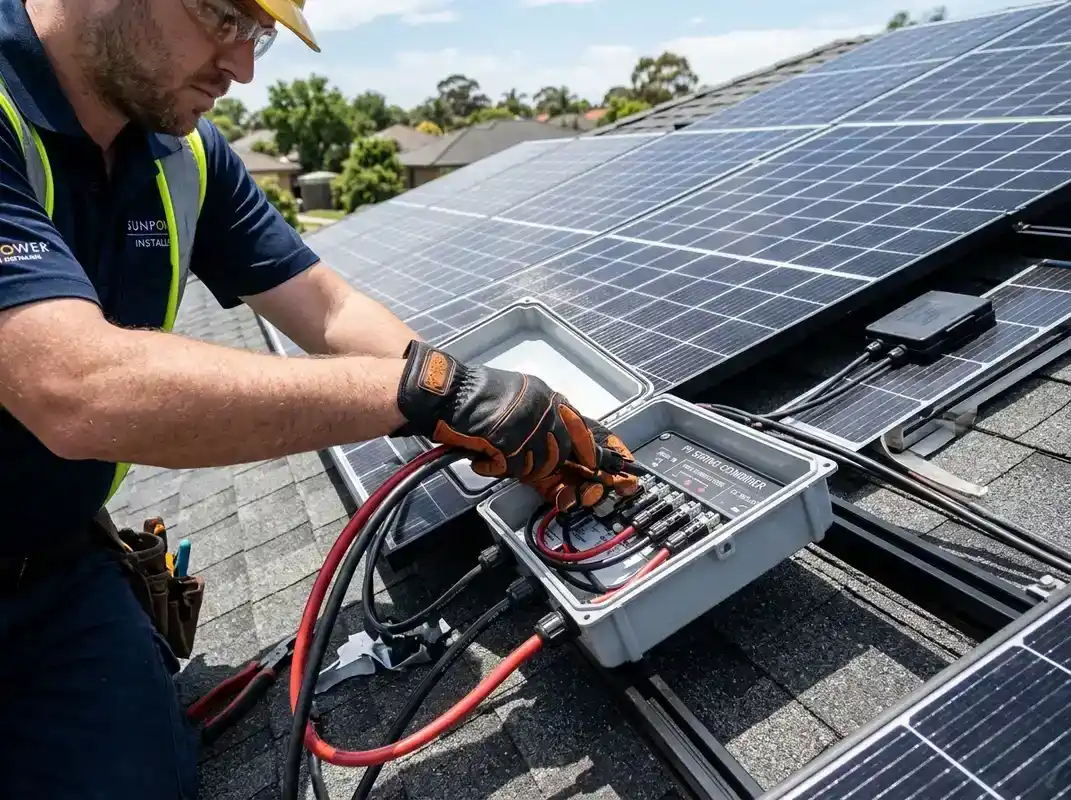
Wiring solar panels incorrectly is the most common reason DIY home backup systems fail before the first grid outage. While connecting photovoltaic (PV) modules seems as simple as snapping MC4 connectors together, choosing between series, parallel, or a hybrid series-parallel array fundamentally dictates your system’s operating efficiency, wire gauge requirements, and inverter safety.
An improper configuration can either leave your charge controller starved for voltage on overcast days or deliver a destructive overvoltage spike that permanently fries your hybrid inverter during sub-zero winter mornings.
Here is the practical electrical engineering breakdown for sizing and wiring solar panels to charge a modern residential battery backup system safely.
The Electrical Core: Voltage, Amperage, and MPPT Windows
Every solar charge controller and hybrid inverter features a Maximum Power Point Tracking (MPPT) operating window defined by two critical metrics: minimum startup voltage and maximum open-circuit voltage ($V_{oc}$).
- Wiring in Series (Increases Voltage, Keeps Amperage Identical): Connecting the positive lead of Panel A to the negative lead of Panel B doubles the string voltage while the array amperage remains equal to a single module.
- Wiring in Parallel (Increases Amperage, Keeps Voltage Identical): Connecting positive leads together via branch combiners and negative leads together keeps the array voltage at single-module levels while doubling the continuous current (amperage).
- Series-Parallel (Balanced Hybrid): Pairs or strings of series-connected panels wired in parallel to achieve optimal operating voltage while staying safely within the MPPT current limits.
Series vs Parallel: Technical Comparison for Home Energy Storage
| Factor | Series Wiring (High Voltage String) | Parallel Wiring (High Amperage Array) |
|---|---|---|
| Wire Gauge Requirements | Minimal (Standard 10 AWG PV wire handles long runs up to 100+ ft with negligible loss). | Heavy (Requires thick 6 AWG, 4 AWG, or dedicated combiner busbars to mitigate resistance drop). |
| Cold-Weather Hazard | High risk of controller overvoltage if temperature coefficients are ignored. | Zero risk of overvoltage; operating voltage stays flat. |
| Partial Shade Sensitivity | Severe. Shading a single cell in a series string chokes output across the entire string unless bypass diodes activate. | Resilient. Shaded parallel strings only lose output locally; sibling strings produce at 100% capacity. |
| Low-Light / Dawn Startup | Fast. High base voltage crosses the inverter startup threshold early in the morning and on cloudy days. | Sluggish. Low voltage struggles to clear the battery charging threshold during overcast conditions. |
Why 48V Battery Banks Demand High-Voltage Series Strings
If you followed our core engineering guide on how to size a 48V LiFePO4 battery bank for home backup, you know that a 16-cell lithium pack requires an absorption charge voltage of 56.8V to 58.4V. Buck-type MPPT controllers cannot boost voltage—they step high incoming PV voltage down to battery charging levels.
Consequently, your solar array’s operating voltage ($V_{mp}$) must comfortably exceed 65V to 70V DC at all times to initiate and sustain charging. Wiring modern 400W panels (typically ~40V $V_{mp}$) in pure parallel will not even trigger the charge controller on warm afternoons. A minimum of two to four panels in series is technically mandatory to drive power into a 48V lithium bus.
The Cold-Weather Math: Calculating Open-Circuit Voltage ($V_{oc}$) Safely
Solar panels operate more efficiently in the cold. As ambient temperatures drop, module voltage climbs significantly. Ignoring this phenomenon is the number one cause of fried inverter input boards.
Formula for Adjusted Open-Circuit Voltage ($V_{oc\text{-adjusted}}$):
V_oc(cold) = V_oc(STC) * [1 + (T_min - 25°C) * (Temperature Coefficient of Voc / 100)]Real-World Example:
Suppose you are installing three 450W panels in series connected to an all-in-one inverter with a 150V DC Maximum Input Limit. The panel nameplate lists:
- $V_{oc}$ (STC 25°C): 41.2V
- Temperature Coefficient of $V_{oc}$: -0.28% / °C
- Local Record Low Winter Temperature ($T_{min}$): -15°C (5°F)
Calculating the delta: -15°C - 25°C = -40°C.
Voltage increase: -40 * (-0.28%) = +11.2%.
Adjusted single-panel $V_{oc}$: 41.2V * 1.112 = 45.81V.
Three panels in series: 3 * 45.81V = 137.43V DC.
Because 137.43V is safely beneath the 150V inverter ceiling (providing an 8.3% engineering safety buffer), this 3-panel series string is fully compliant. Adding a fourth panel would push cold voltage to 183.2V, destroying the controller instantly.
NEC Safety & Compliance Standards for Rooftop and Ground Mounts
When engineering an energy storage PV array, residential installations must adhere to the National Electrical Code to maintain insurance compliance and life safety:
- Rapid Shutdown Compliance (NEC Article 690.12): All rooftop PV arrays must include a rapid shutdown initiation switch that drops voltage inside the array boundary to 80V or less within 30 seconds of activation. This allows emergency first responders to operate without electrocution hazards.
- DC Disconnect and Overcurrent Protection (NEC 690.9): When paralleling three or more strings, each string must feature an inline DC fuse or circuit breaker rated to the manufacturer’s Maximum Series Fuse Rating (typically 15A to 25A) to prevent reverse current faults.
- Robust Grounding (NEC Article 250): Aluminum racking and module frames must be bonded using continuous bare copper wire (typically 6 AWG) directly to the home’s grounding electrode system to safely dissipate lightning transients and static buildup.
Best Practice Summary for DIY Home Energy Builders
For residential off-grid and backup installations charging high-capacity battery storage banks (such as the setups detailed in our comparison between LiFePO4 vs Lead-Acid for home backup), series-parallel arrays offering 120V to 350V nominal string voltage provide the sweet spot. They minimize resistive cable heating, eliminate the need for unwieldy copper gauge wire, and maintain high harvesting efficiency from early dawn to late dusk.