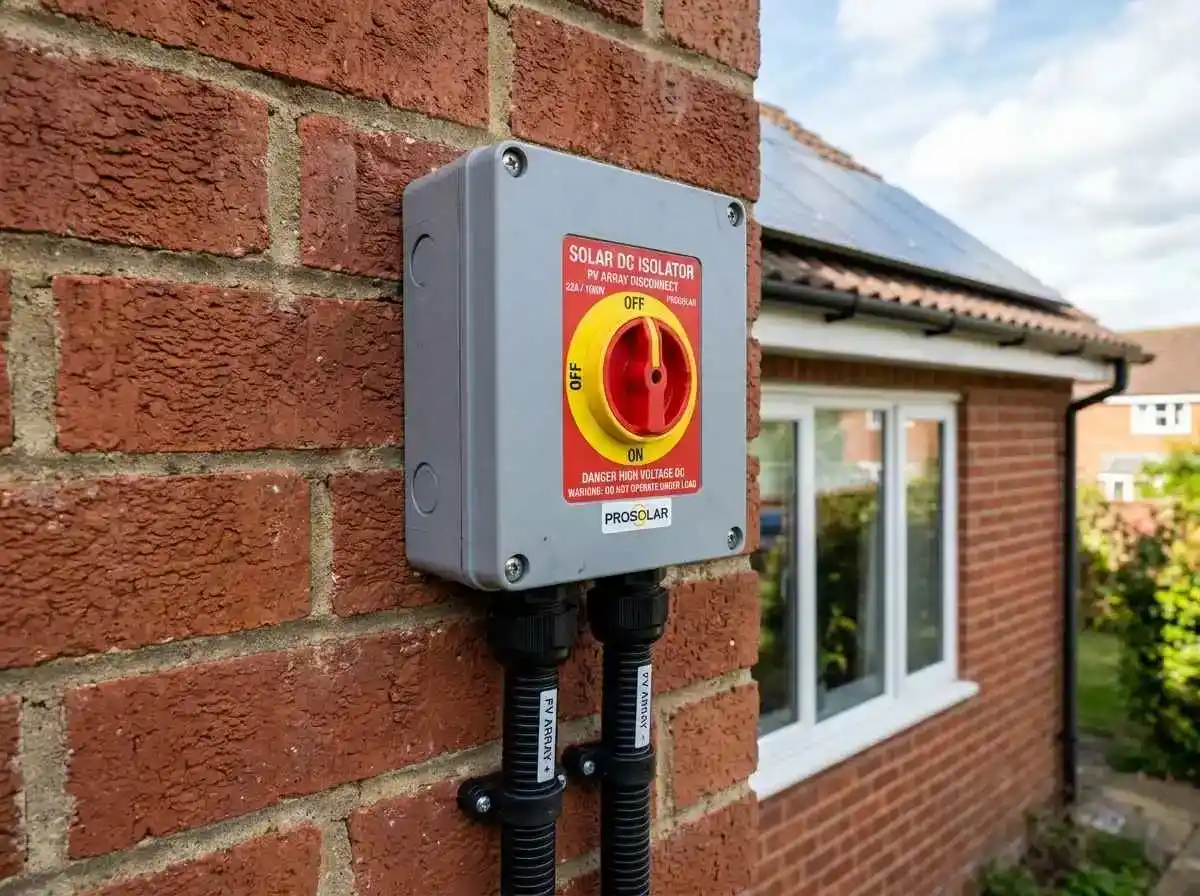
Direct current (DC) generated by photovoltaic arrays does not cross a zero-voltage threshold dozens of times per second like alternating current (AC). Consequently, an electrical arc formed in a high-voltage DC string will not extinguish on its own; it burns continuously, melting conduit boxes and posing severe structural fire hazards if interrupted with improper switchgear.
To safely isolate rooftop solar panels for maintenance and provide first responders with emergency de-energization capabilities, residential installations must implement code-compliant DC disconnects (isolators) and Rapid Shutdown Systems per National Electrical Code (NEC) standards.
Here is the technical guide for sizing switchgear ampacity, matching voltage ratings, and satisfying NEC Article 690 rapid shutdown mandates on residential battery backup systems.
DC Arc Extinction vs Standard AC Switches
A fatal DIY mistake is installing standard AC circuit breakers or knife switches on solar array feeds. Because AC current alternates 60 times per second, the voltage drops to zero periodically, naturally quenching small electrical sparks across opening switch contacts.
DC power maintains continuous potential. When high-voltage DC contacts separate under load, an ionized plasma arc bridges the physical gap. Purpose-built solar DC isolators feature:
- Magnetic Arc Chutes: Permanent magnets that draw the electrical arc away from metallic contacts and force it into cooling fins.
- Snap-Action Spring Mechanisms: High-speed internal trip springs that separate mechanical contacts in milliseconds regardless of how slowly a human turns the external handle.
- True Bi-Directional Ratings: Enclosures rated to safely interrupt continuous currents up to 600V or 1,000V DC without thermal destruction.
Sizing the Solar DC Disconnect: Ampacity & Voltage Math
Sizing a DC disconnect requires calculating both maximum potential string voltage under freezing conditions and maximum short-circuit current per NEC Article 690.8.
1. Voltage Ceiling Calculation
The isolator’s maximum rated voltage must strictly exceed the array’s cold-weather open-circuit voltage ($V_{oc}$), calculated as outlined in our guide on DIY solar panel wiring (series vs parallel):
Maximum System Voltage = STC Open Circuit Voltage (Voc) × Cold Temperature Correction FactorIf a 4-panel series string produces an adjusted $V_{oc}$ of 210V DC in sub-zero winter mornings, your DC isolator must carry a minimum working voltage rating of 300V to 600V DC.
2. Continuous Current Rating (The 125% Rule)
Per NEC standards, PV source circuit switchgear must be rated for at least 125% of the array’s Short-Circuit Current ($I_{sc}$) to account for atmospheric irradiance magnification:
Minimum Disconnect Current = Array Isc × 1.25For an array with parallel strings generating a combined $I_{sc}$ of 26 Amps:
- Raw Current: 26 Amps
- NEC Safety Factor:
26A × 1.25 = 32.5 Amps
Result: Select a standard 40A or 63A DC-rated rotary isolator switch.
Quick Disconnect Selection Matrix
| String Voltage Range (Cold Voc) | Total Array Isc | Required Disconnect Voltage | Minimum Continuous Amp Rating | Recommended Switch Type |
|---|---|---|---|---|
| Under 150V DC | 10A – 15A | 300V DC | 20A – 25A | Rotary DIN-Rail DC Isolator |
| 150V – 300V DC | 20A – 30A | 600V DC | 40A – 50A | Heavy-Duty Enclosed DC Rotary |
| 300V – 500V DC | 25A – 35A | 600V DC | 50A – 63A | Molded Case DC Breaker / Disconnect |
NEC 690.12 Rapid Shutdown Requirements Explained
While an exterior DC isolator cuts power at ground level, the conductors running between rooftop solar panels and the isolator remain energized at high voltage in daylight. If firefighters must ventilate a burning roof, cutting into these live cables presents an extreme shock hazard.
NEC Article 690.12 mandates Rapid Shutdown Systems (RSS) for all building-mounted residential PV arrays:
- Controlled Boundary: The boundary extends 1 foot (305 mm) from the array in all directions and 3 feet (1 m) from point of entry into a structure.
- Inside the Array Boundary: Voltage must drop to 80V or less within 30 seconds of rapid shutdown initiation.
- Outside the Array Boundary: Voltage must drop to 30V or less within 30 seconds.
To achieve this, modern systems pair module-level power electronics (MLPEs, such as Tigo or APsystems receivers) behind every panel, linked to a central transmitter or initiating push-button switch at ground level.
Integration with MPPTs and Battery Storage
A solar disconnect must be placed on the DC input line directly before the charge controller to permit servicing without cutting battery power. After safely extinguishing solar input via the isolator, your controller can finish regulating battery reserves.
Review our engineering guides on sizing MPPT charge controllers and over-paneling limits and configuring 16S BMS continuous current protection to maintain complete end-to-end electrical safety throughout your power room.
Summary
Safely isolating high-voltage solar energy requires purpose-built DC switchgear designed with magnetic arc suppression and sized to 125% of short-circuit current. Combining a properly calculated rotary DC isolator with a rapid shutdown initiator ensures your rooftop array complies with NEC life-safety regulations while protecting your home during emergency events.