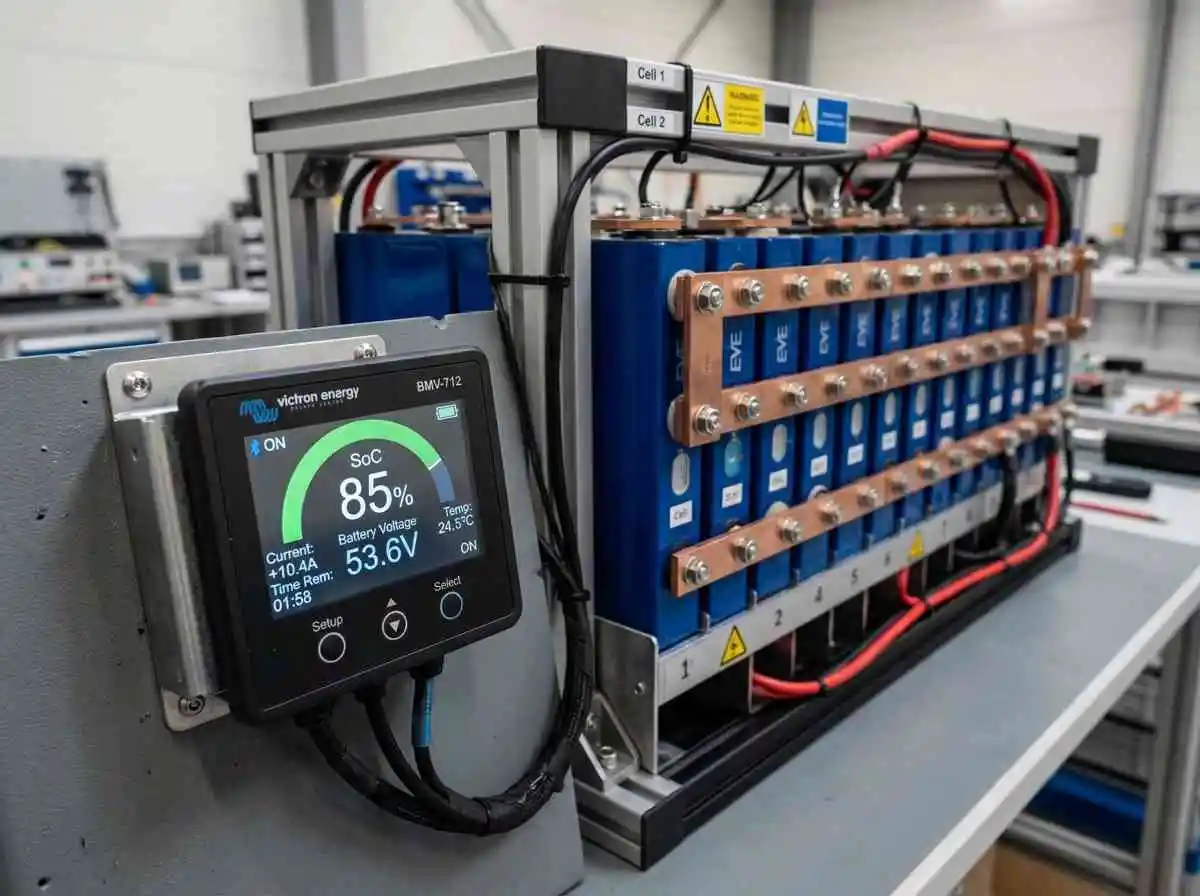
Lithium Iron Phosphate (LiFePO4) has rightfully earned its reputation as the most durable chemistry for residential energy storage, frequently marketed with promises of “6,000+ cycles to 80% capacity.” However, in real-world stationary residential installations, standard cycle life represents only half of the aging equation. A battery sitting fully saturated at elevated voltages experiences degradation even when no current is flowing.
To engineer a 48V home battery bank capable of operating reliably for 12 to 15 years, system designers must account for both cycle degradation (damage inflicted by active charging and discharging) and calendar degradation (chemical breakdown induced by prolonged mechanical state-of-charge stress and ambient temperature).
Here is the electrochemical breakdown of cell aging mechanisms, mathematical analysis of Depth of Discharge (DoD), and practical charger calibration guidelines for maximum storage lifespan.
Cycle Aging vs Calendar Aging: The Electrochemical Mechanisms
Understanding how a LiFePO4 cell ages dictates how you configure your hybrid inverter and charge controller thresholds:
1. Cycle Degradation (Mechanical Lattice Strain)
During every charge and discharge phase, lithium ions de-intercalate from the cathode and wedge into the graphite anode matrix. This physical migration causes micro-expansion and contraction of the electrode lattice structure (roughly 1% to 2% volume change). Over thousands of iterations, this mechanical stress causes micro-cracking, fracturing conductive pathways and permanently isolating active material.
2. Calendar Degradation (Parasitic Chemical Reactions)
Even if an off-grid battery sits idle during a sunny week, internal electrochemical processes continue. The primary culprit is the growth of the Solid Electrolyte Interphase (SEI) layer on the anode surface. As the SEI layer thickens, it consumes active mobile lithium ions and increases internal cell resistance (impedance).
The rate of SEI growth is governed by the Arrhenius equation and electrochemical potential:
- Elevated Voltage Acceleration: Keeping cells held at 3.65V (100% saturation) exposes the organic liquid electrolyte to severe oxidation stress, accelerating irreversible lithium loss.
- Thermal Acceleration: Every 10°C (18°F) rise in sustained ambient operating temperature doubles the rate of parasitic SEI growth reactions.
Depth of Discharge (DoD) vs Usable Cycle Lifespan
While marketing materials tout 100% DoD capability, operating across shallower discharge envelopes dramatically increases cumulative kilowatt-hour throughput over the system’s operational lifetime:
| Depth of Discharge (DoD) | Usable Working Window | Expected Cycle Count to 80% SOH | Lifetime Delivered kWh (Per 10 kWh Bank) |
|---|---|---|---|
| 100% DoD | 0% to 100% SoC | ~3,000 Cycles | ~24,000 kWh |
| 80% DoD | 10% to 90% SoC | ~6,000 Cycles | ~43,200 kWh (+80% gain) |
| 70% DoD | 15% to 85% SoC | ~8,500 Cycles | ~50,490 kWh (+110% gain) |
As demonstrated in our baseline framework for sizing 48V LiFePO4 battery banks, configuring a 20% reserve margin (operating between 10% and 90% state-of-charge) nearly doubles total delivered energy over the cell’s lifespan while leaving sufficient emergency reserve for prolonged grid blackouts.
Calibrating Charge Voltages: Absorption vs Float Math
Most default inverter profiles apply excessive voltage ceilings designed for older lead-acid banks or generic lithium profiles. To arrest calendar degradation on a 16S (48V nominal) LiFePO4 bank, program customized charging setpoints:
1. Bulk / Absorption Voltage (The 3.45V Sweet Spot)
Many manufacturers recommend charging cells to 3.65V per cell (58.4V total bank). However, empirical coulometric testing reveals that a cell reaches 98.5% full saturation at just 3.45V per cell. Forcing the cell from 3.45V to 3.65V yields negligible extra energy while quadrupling electrolyte degradation stress.
- Factory Lithium Default: 58.4V (3.65V/cell) — Aggressive / Accelerates calendar aging.
- Optimized Conservative Setting: 55.2V (3.45V/cell) with a 20-to-30 minute absorption hold time.
2. Float Voltage (Resting Equilibrium)
Once absorption charging finishes, the inverter must lower potential to the natural resting voltage of LiFePO4. Holding cells at float voltages above 3.40V causes slow, continuous calendar degradation.
- The true resting voltage of a fully saturated LiFePO4 cell is 3.35V to 3.37V.
- Set your 48V inverter float parameter to 53.6V to 54.0V (3.35V–3.375V per cell).
This allows active solar generation to power daytime household loads audited per our whole-home energy audit guide without forcing high chemical potential onto the idle battery cells.
Cell Balancing Interlock with Charge Setpoints
When selecting your charge ceiling, you must coordinate settings with your battery management system. As outlined in our guide on choosing and sizing a 16S BMS, passive balancing resistors only engage when cell voltages rise above their balancing start threshold (typically 3.40V).
If you program an absorption voltage of 55.2V (3.45V/cell), ensure your BMS balancing start threshold is set to 3.42V with an active delta trigger of 15mV. This ensures cells maintain cell-to-cell balance during the final 30 minutes of charge absorption before dropping down to the 53.6V float level.
Thermal Management for Calendar Longevity
Temperature exerts immense leverage on calendar degradation. While winter risks require deploying thermostatically controlled heating blankets per our cold-weather LiFePO4 protection protocol, summer thermal exposure is equally damaging:
- Ideal Ambient Operating Zone: 15°C to 25°C (59°F to 77°F).
- Severe Degradation Threshold: Sustained ambient operation above 35°C (95°F) doubles the calendar aging rate, turning a 15-year battery asset into an 8-year replacement liability.
Always install storage racks in well-ventilated, insulated indoor spaces or conditioned utility rooms rather than unventilated attics or direct-sunlight garage corners.
Summary
Maximizing the lifespan of a 48V LiFePO4 battery bank requires shifting focus from simple cycle counting to mitigating calendar degradation. By capping absorption voltage at 55.2V (3.45V/cell), lowering float potential to 53.6V (3.35V/cell), restricting daily depth of discharge to 80%, and maintaining core temperatures below 25°C, homeowners can easily extend battery longevity well beyond a decade of reliable daily backup performance.