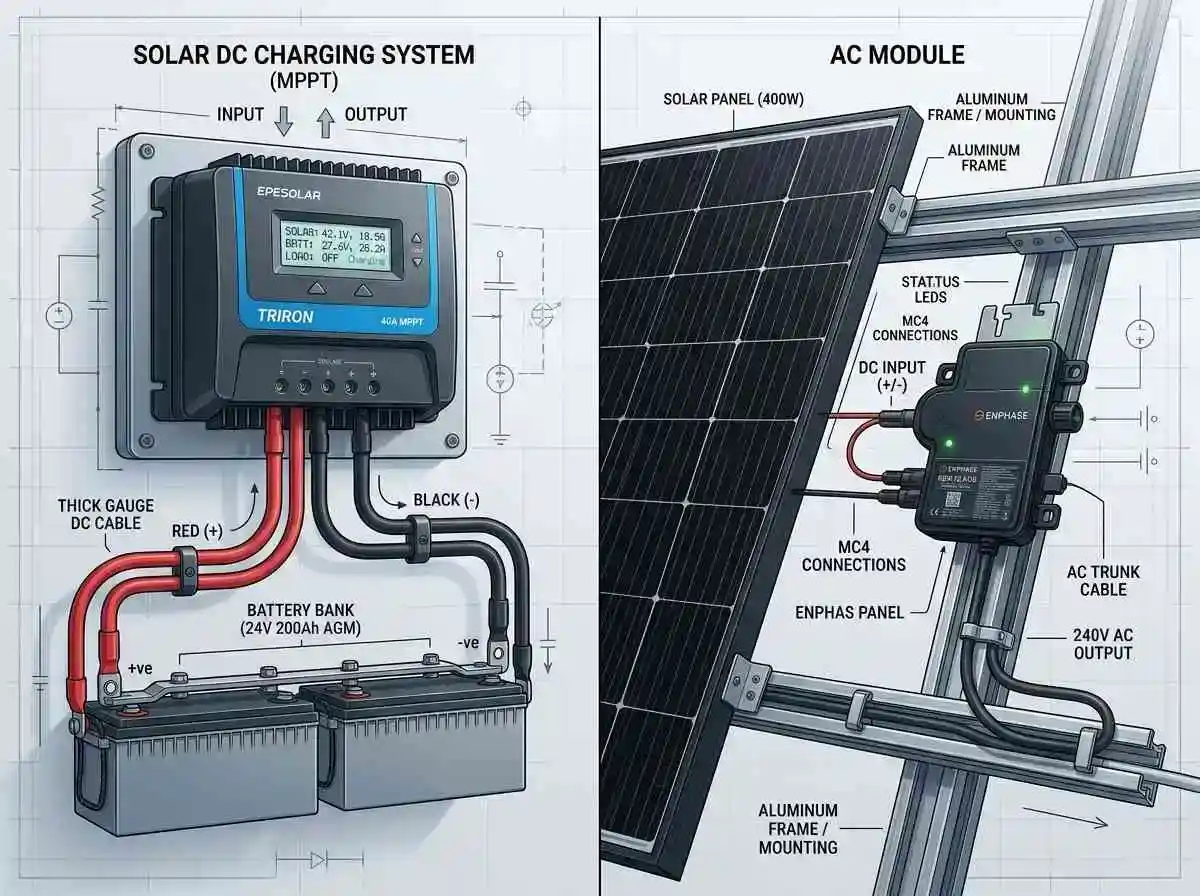
When engineering a residential solar array with battery storage, one of the most consequential design decisions is how to route the solar energy into the battery bank. Homeowners are generally presented with two distinct architectural pathways: DC-Coupled systems (utilizing traditional string panels and MPPT charge controllers) and AC-Coupled systems (utilizing roof-mounted microinverters).
While microinverters dominate the standard grid-tied solar market due to their ease of installation and panel-level monitoring, integrating them into an off-grid or battery-backed microgrid introduces significant engineering complexities. Sending alternating current (AC) into a direct current (DC) battery bank requires specialized hardware and precise frequency modulation.
Here is the technical breakdown of AC-Coupled vs DC-Coupled architectures, the penalty of the “double-inversion” process, and how to choose the right topology for a 48V energy storage system.
DC-Coupled Systems: The Gold Standard for Off-Grid
In a DC-Coupled system, the solar panels generate high-voltage Direct Current (DC). This power travels down the conduit directly into an MPPT charge controller, which steps the voltage down to match the 48V battery bank. The battery then feeds a central inverter to produce AC power for the home.
Advantages of DC Coupling:
- Maximum Efficiency: Solar power goes from DC (panels) to DC (battery) with only a 2% to 4% conversion loss.
- Black-Start Capability: If the battery bank completely dies, the MPPT can wake up the system the moment the sun rises, recharging the battery without needing an AC grid signal.
- Simplicity: DC-coupled architecture naturally avoids overcharging. When the battery is full, the MPPT simply raises its input resistance and stops pulling current from the panels.
AC-Coupled Systems: The Retrofit Solution
If a home already possesses a grid-tied solar system featuring microinverters (like Enphase IQ series) or a string inverter (like SolarEdge), the solar panels output 240V Alternating Current (AC) directly from the roof.
To store this energy, an AC-Coupled architecture requires a specialized bi-directional hybrid inverter (such as a Sol-Ark or Victron MultiPlus). The rooftop microinverters feed AC power into the hybrid inverter’s subpanel. The hybrid inverter then rectifies (converts) that AC power back into DC power to charge the 48V battery.
The “Double-Inversion” Penalty
AC-Coupling introduces a thermodynamic penalty because the energy must change states multiple times before reaching your appliances during a nighttime outage:
- DC (Panels) → AC (Microinverter) = ~4% Loss
- AC (Microinverter) → DC (Hybrid Inverter Rectifier charging the battery) = ~5% Loss
- DC (Battery) → AC (Hybrid Inverter powering the house at night) = ~8% Loss
Total System Loss: Up to 17% of harvested solar energy is lost as heat during the conversion cycles, compared to just 10% in a purely DC-Coupled system.
Managing Overcharge: Frequency-Watt Shifting
The most critical challenge of AC-Coupling occurs during grid outages. When the utility grid is down, the hybrid inverter must form a localized “micro-grid” to keep the roof microinverters awake. But what happens when the solar panels are producing 8,000W of AC power at noon, the house only needs 1,000W, and the battery is at 100% capacity?
Because AC power cannot simply be “shut off” without damaging equipment, the hybrid inverter utilizes Frequency-Watt Control (IEEE 1547). As detailed in our guide on smart load shedding and microgrid automation, the hybrid inverter intentionally alters the local 60.0 Hz AC frequency:
- 60.0 Hz to 60.2 Hz: Normal operation; microinverters output 100% power.
- 60.5 Hz: Microinverters detect grid instability and throttle output down to 50%.
- 61.0 Hz: Microinverters execute an emergency shutdown to prevent battery overcharging.
While effective, this constant frequency shifting can cause UPS (Uninterruptible Power Supply) units on computers to click on and off, and may interfere with sensitive synchronous AC motors.
Shading Mitigation: Microinverters vs DC Optimizers
The primary marketing argument for AC microinverters is shade tolerance. If one panel is shaded, it does not drag down the rest of the array.
However, you do not need AC microinverters to solve partial shading. As established in our technical breakdown of bypass diodes and shading math, a DC-Coupled system can achieve the exact same shade mitigation by deploying DC Optimizers (like Tigo TS4 modules) behind each panel. This retains the high efficiency of DC charging while providing panel-level tracking and NEC rapid shutdown compliance.
Summary: Which Topology is Right for You?
If you are building a new emergency backup system from scratch, a DC-Coupled architecture is undeniably superior for off-grid resilience, offering higher efficiency, seamless black-start capabilities, and no frequency-shifting hardware conflicts.
If you are retrofitting batteries onto a house that already has a sizable grid-tied microinverter array, AC-Coupling is the most cost-effective path. Just ensure you select a heavy-duty hybrid inverter capable of handling the full AC output of the roof, and account for a 15% round-trip conversion loss in your battery capacity calculations.