When utility grid power fails, even a generously sized residential battery bank faces immediate depletion if heavy 240V household appliances cycle on unchecked. Electric resistive water heaters, level-2 EV chargers, clothes dryers, and secondary air conditioning zones can silently consume 15 to 25 kilowatt-hours within a single afternoon, leaving critical medical equipment, refrigeration, and communications dark by nightfall.
Historically, avoiding battery collapse meant either spending tens of thousands of dollars on massive battery capacity or manually toggling breakers inside a dark basement. Today, automated load shedding relays and intelligent smart panels bridge this operational gap, dynamically disconnecting secondary resistive loads when battery state-of-charge (SoC) drops or overall continuous inverter limits are reached.
Here is the engineering guide for sizing automated load shedding contactors, configuring frequency-based disconnects, and automating critical load preservation during extended outages.
The Physics of Load Priority: Essential vs Discretionary
A resilient home power architecture divides electrical consumption into distinct tiers, as established in our foundational guide on whole-home energy audits and critical load panels:
- Tier 1 (Non-Negotiable Baseline): Well pump, refrigerators/freezers, home network/routers, medical equipment, and security lighting (~800W to 1,500W continuous).
- Tier 2 (Modulated Comfort): Central heat pump or mini-split systems equipped with an electronic soft starter to mitigate LRA surges (~1,800W to 3,500W).
- Tier 3 (Discretionary High-Draw): Electric water heating tanks (4,500W), electric vehicle charging stations (7,200W–11,500W), electric ovens, and hot tubs.
The goal of automated load shedding is simple: instantly disconnect Tier 3 circuits the millisecond grid power is lost, allowing your battery to supply Tier 1 and Tier 2 loads without the risk of an inverter overload trip.
Methods of Load Shedding: Relays vs Smart Panels
There are two primary hardware approaches to modern load management:
| Feature | Heavy-Duty Definite Purpose Contactors | Microprocessor Smart Panels (e.g., Span, Lumin) |
|---|---|---|
| Hardware Cost | Low ($60 – $150 per circuit) | High ($2,000 – $4,500+ panel replacement) |
| Control Mechanism | 12V/24V trigger coil tied to inverter AUX relay | Software-defined via Wi-Fi/Ethernet app scheduling |
| Response Latency | Instantaneous physical drop (10ms to 25ms) | Sub-second digital gateway command |
| Installation Retrofit | Installs inline between breaker and heavy load | Requires complete main distribution replacement |
| Off-Grid Reliability | Failsafe hardware link (immune to cloud/Wi-Fi drops) | Requires local bridge gateway during internet outage |
Sizing Definite Purpose Contactors for Heavy 240V Loads
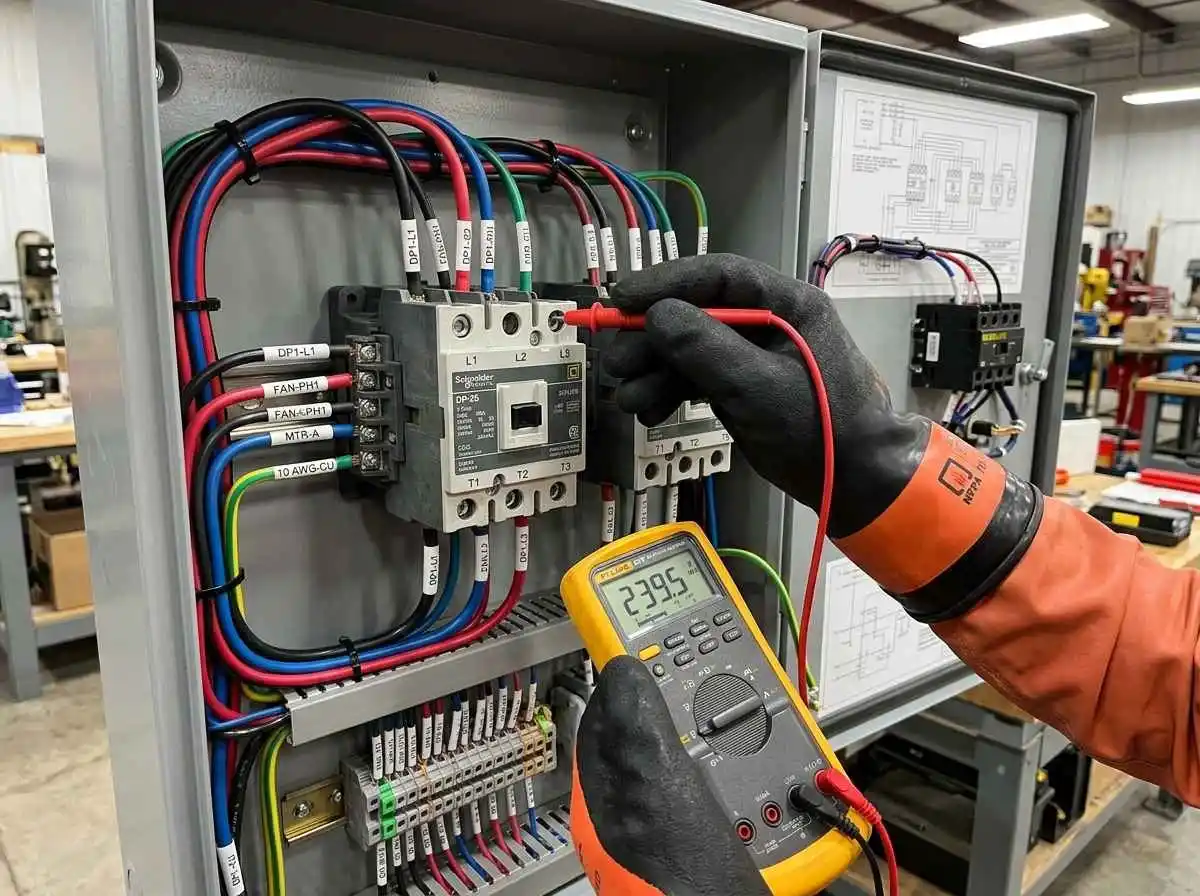
For DIY and cost-effective installations, integrating a heavy-duty Normally Open (NO) or Normally Closed (NC) Definite Purpose Contactor inside an auxiliary NEMA enclosure provides bulletproof isolation.
Ampacity Sizing Formula (NEC Continuous Duty):
Contactor Rated Amps ≥ Continuous Branch Current × 1.25Consider an electric water heater pulling 4,500 Watts at 240 Volts:
- Operating Current:
4,500W / 240V = 18.75 Amps - NEC Continuous Safety Factor:
18.75A × 1.25 = 23.4 Amps - Contactor Selection: A standard 30A or 40A two-pole definite purpose contactor with an appropriately matched control coil voltage (typically 12VDC, 24VDC, or 120VAC).
By wiring the coil to the programmable dry auxiliary contact of your hybrid inverter or your automatic transfer switch (ATS), the contactor automatically opens whenever the inverter senses off-grid operation, instantly removing the 4.5 kW water heater from the battery bank.
Frequency-Shift Load Management
For advanced AC-coupled systems (where grid-tied microinverters feed directly into a battery inverter subpanel), sophisticated load shedding relies on Frequency-Watt controls per IEEE 1547 standards:
- Normal Grid Frequency: 60.0 Hz.
- Stage 1 Curtailment (60.5 Hz): The hybrid inverter intentionally elevates micro-grid frequency to 60.5 Hz when battery state-of-charge reaches 95%. Solar microinverters gradually throttle down output to prevent overcharging.
- Stage 2 Load Disconnect (61.0 Hz – 62.0 Hz): Frequency-sensitive load-shedding modules (such as Generac SMMs) detect the elevated frequency and immediately drop large discretionary loads, ensuring the battery never absorbs hazardous reverse currents.
Integrating Battery State-of-Charge (SoC) Triggers
The smartest load management is dynamic, responding directly to battery reserves rather than simple on/off grid status:
- Battery SoC > 80%: All circuits operate normally; surplus solar can heat water or charge electric vehicles.
- Battery SoC Drops to 50%: The system AUX relay trips, de-energizing EV chargers and electric heat pumps, shifting the home into conservation mode.
- Battery SoC Drops to 20%: All discretionary lighting and minor subpanel circuits drop, reserving remaining energy exclusively for the DC low-voltage heating blankets protecting the cells per our cold weather LiFePO4 thermal protection protocol.
Summary
Automating load shedding transforms an ordinary battery backup system into an intelligent, highly resilient microgrid. By installing properly sized definite purpose contactors or smart load-management modules on non-essential 240V circuits, you prevent instantaneous overload trips, double your off-grid autonomy during prolonged utility blackouts, and eliminate the need for manual breaker management in emergencies.