Air conditioning compressors and modern heat pumps represent the single largest electrical hurdle when transitioning a home to off-grid battery backup. While a 3-ton central AC unit might only consume 3,000 to 3,500 running watts, starting that compressor from a complete dead stop requires an instantaneous surge of inductive current that can overwhelm even high-capacity lithium inverters.
This inductive startup spike—formally designated as Locked Rotor Amperage (LRA)—can pull 5 to 7 times the continuous running amperage for several alternating current cycles. Without mitigation, this forces hybrid inverters into overload shutdown, induces destructive voltage sags across critical load panels, and prematurely degrades battery management contactors.
Installing an electronic microcontroller-based soft starter eliminates this bottleneck. Here is the engineering breakdown of LRA reduction math, soft starter sizing protocols, and battery inverter integration.
The Physics of Compressor Inrush: RLA vs LRA
Every residential condensing unit and heat pump features an electrical service nameplate with two critical metrics defined by the Air-Conditioning, Heating, and Refrigeration Institute (AHRI):
- Rated Load Amps (RLA): The continuous current drawn while the motor operates under full mechanical compression load.
- Locked Rotor Amps (LRA): The peak current drawn by the motor rotor during the initial 100 milliseconds before rotational electromagnetic momentum is established.
During direct-on-line (across-the-line) contactor closure, stationary compressor windings present near-zero counter-electromotive force (CEMF). A standard 3.5-ton AC unit with an RLA of 16A typically exhibits an LRA of 75A to 110A at 240V:
Peak Inrush Demand = 110 Amps × 240 Volts = 26,400 Surge Watts (26.4 kW)As calculated in our benchmark guide on conducting a whole-home energy audit and sizing critical load panels, very few residential battery inverters can supply a 26 kW instantaneous spike without initiating protective low-voltage shutdown.
How an Advanced Soft Starter Works (vs Hard Start Kits)
Homeowners often confuse inexpensive hard start kits with soft starters, but their mechanical operating principles are fundamentally opposite:
| Parameter | Hard Start Kit (Start Capacitor + Potential Relay) | Microcontroller Soft Starter (PWM Ramp-Up) |
|---|---|---|
| Operating Method | Adds massive capacitive boost to shove the rotor faster | Dynamically regulates voltage waveform across AC sine waves |
| LRA Current Spike | Increases or maintains high inrush current for a shorter duration | Reduces physical inrush current by 60% to 70% |
| Mechanical Stress | High mechanical jerk on motor bearings and scroll plates | Smooth, gradual acceleration; minimizes thermal and physical shock |
| Battery Inverter Compatibility | Poor (Surge wattage still trips standard off-grid inverters) | Excellent (Allows small 5 kW–8 kW inverters to start large AC units) |
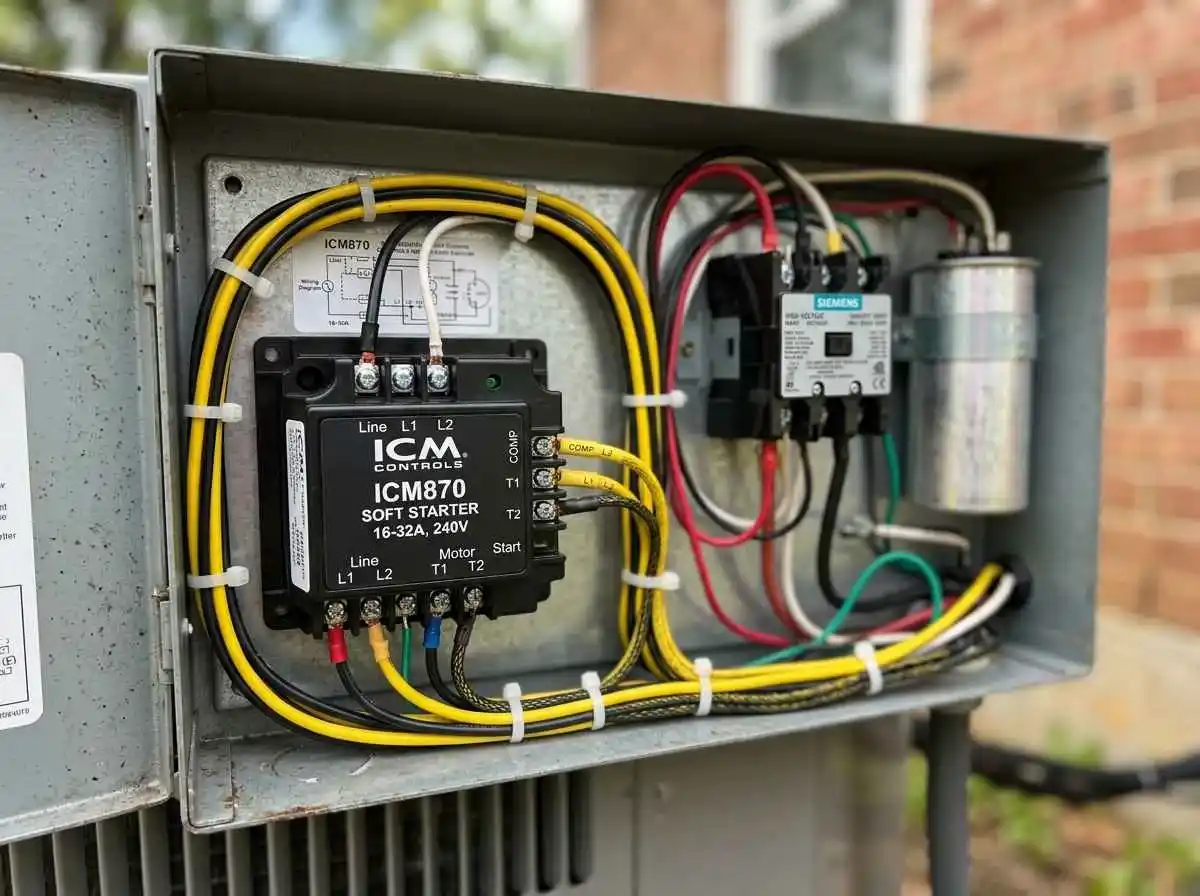
An intelligent soft starter (such as a Micro-Air EasyStart or ICM870) utilizes an onboard microprocessor with closed-loop current sensing. Over its first 5 to 10 learning cycles, it maps the precise mechanical torque profile of the compressor, switching high-speed triacs to gradually ramp current across the start and run windings over 100 to 300 milliseconds.
Soft Starter Sizing Matrix (BTU and Tonnage Match)
Selecting the correct soft starter requires matching the unit to your compressor’s tonnage and maximum running load amperage (RLA):
| AC / Heat Pump Capacity | Typical Running Amps (RLA) | Standard Factory LRA | LRA with Soft Starter (~65% Drop) | Recommended Soft Starter Rating |
|---|---|---|---|---|
| 1.5 to 2.0 Tons (18k–24k BTU) | 8A – 12A | 45A – 60A | 15A – 21A | Single-Phase 16A Continuous Unit |
| 2.5 to 3.5 Tons (30k–42k BTU) | 13A – 18A | 70A – 105A | 24A – 36A | Single-Phase 20A – 25A Unit |
| 4.0 to 5.0 Tons (48k–60k BTU) | 20A – 26A | 115A – 150A | 40A – 52A | Single-Phase 32A – 36A Heavy-Duty Unit |
Inverter and Battery Bank Sizing Benefits
Integrating a soft starter radically alters your upstream hardware requirements:
- Downsized Inverter Capacity: Instead of purchasing an expensive 12 kW or 15 kW split-phase inverter solely to tolerate 26 kW startup surges, a standard 6,000W to 8,000W hybrid inverter easily handles a soft-started 3-ton AC unit while concurrently powering refrigeration and lighting circuits.
- Reduced DC Battery Stress: Reviewing our calculations for BMS continuous discharge sizing, pulling 110A at 240V AC translates to over 550A DC at the 48V battery terminals. An unmitigated startup spike trips the overcurrent thresholds of standard 200A BMS units. With a soft starter, DC draw drops to manageable levels (~180A DC peak), well within safe battery operating boundaries.
- Seamless Generator & Transfer Switch Handover: When switching sources via an automatic transfer switch (ATS), soft start technology prevents engine bogging and frequency fluctuations on backup generators or sudden inverter load disconnects.
NEC Wiring and Overcurrent Considerations
When installing a soft starter inside the outdoor condenser enclosure, ensure compliance with NEC Article 440 (Air-Conditioning and Refrigerating Equipment):
- Preserve Branch Circuit Protection: The soft starter does not alter your branch circuit breaker or Minimum Circuit Ampacity (MCA) ratings. If the unit requires a 30A double-pole breaker and 10 AWG copper wire, maintain that specification regardless of reduced startup current.
- Refrigerant Pressure Equalization: Always configure a 3-minute minimum short-cycle delay in your thermostat or soft starter settings. Attempting to start a compressor against high residual head pressure will trigger thermal overload switches.
Summary
Locked Rotor Amperage is the primary obstacle to powering residential cooling systems during utility outages. By installing a dedicated electronic soft starter, you reduce startup surge requirements by over 60%, protecting your compressor and allowing a modest 48V battery backup system to run whole-home heat pumps smoothly.
2 thoughts on “Soft Starter Sizing for AC and Heat Pumps on Battery Backup: LRA Reduction Guide”