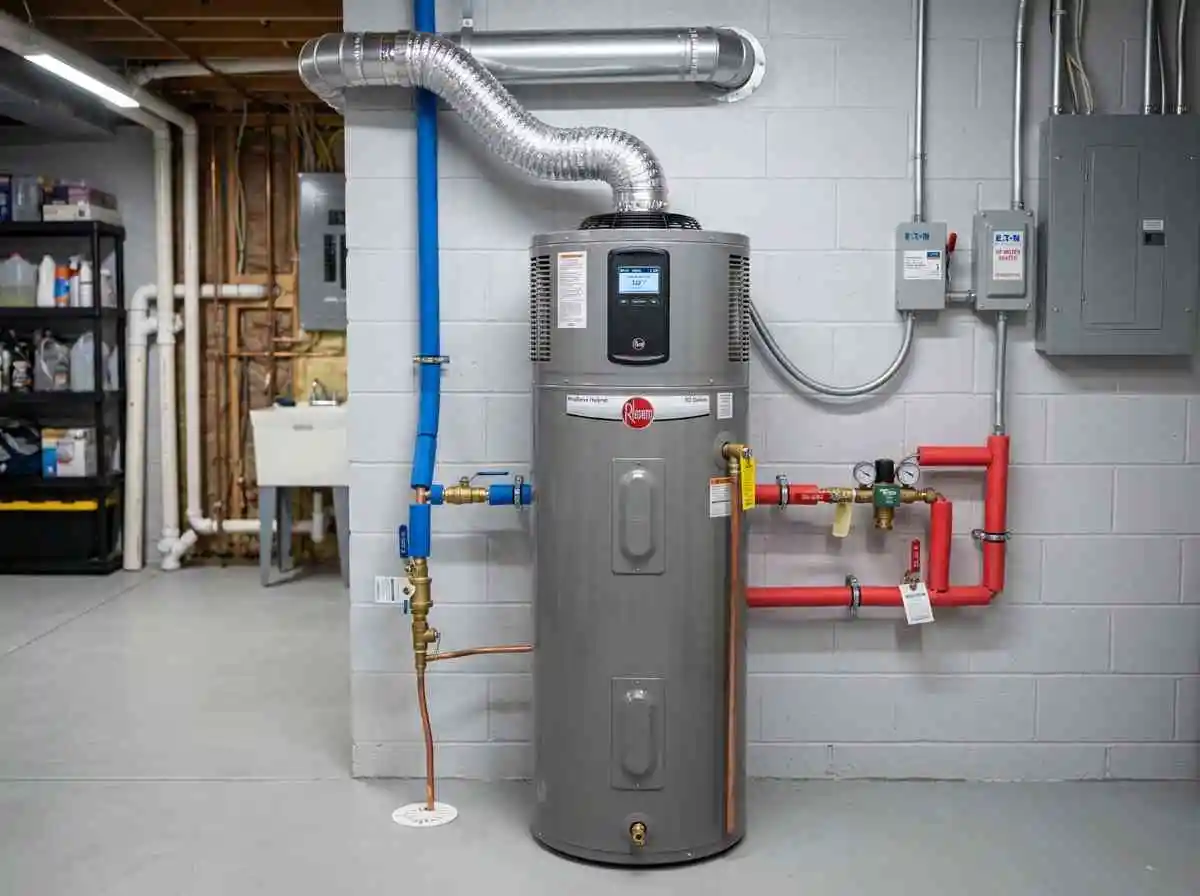
Water heating represents roughly 18% of an average home’s total energy footprint, ranking directly behind space heating and cooling as the largest continuous residential electrical draw. Traditional electric storage water heaters rely on dual resistive heating elements that demand 4,500W to 5,500W continuously. Running a standard resistive tank on an emergency battery backup will drain a 15 kWh lithium bank in less than three hours.
Hybrid Heat Pump Water Heaters (HPWH) radically transform this electrical equation. By utilizing a small vapor-compression refrigeration circuit to extract ambient heat from surrounding air and pump it into the domestic water tank, modern heat pump units deliver a Coefficient of Performance (COP) between 3.0 and 4.2. In pure heat pump mode, steady-state power draw drops from 4,500W down to a modest 350W to 500W.
Here is the engineering analysis for sizing hybrid water heaters on residential battery backup systems, calculating hot water recovery rates, and configuring operational modes to prevent inverter overload.
Electrical Profile: Resistive vs Hybrid Heat Pump
To evaluate the impact on battery reserves, compare the electrical draw of a standard 50-gallon tank against an equivalent hybrid heat pump unit:
| Operational Metric | Standard Electric Water Heater | Hybrid HPWH (Heat Pump Mode) | Hybrid HPWH (Hybrid / High-Demand) |
|---|---|---|---|
| Continuous Running Draw | 4,500 Watts | 350W – 500 Watts | 4,500 Watts (Elements engaged) |
| Daily Energy (60 gal/day) | ~12.5 kWh / day | ~2.8 to 3.4 kWh / day | ~6.5 to 8.0 kWh / day |
| Operating Voltage | 240V AC (Split-Phase) | 240V AC (or 120V dedicated plug-in) | 240V AC (Split-Phase) |
| Circuit Breaker Size | 30A Double-Pole (10 AWG) | 15A to 30A Double-Pole | 30A Double-Pole |
| Battery Impact (15 kWh Bank) | Drains 83% of total storage daily | Consumes only ~20% of storage daily | High risk of premature low-voltage cutoff |
Understanding Operational Modes During Grid Outages
Hybrid water heaters (such as Rheem ProTerra or A.O. Smith Voltex) offer selectable operating profiles via their digital control interfaces. When running on off-grid battery power, configuring the correct mode is critical:
1. Heat Pump Only Mode (Recommended for Battery Backup)
In this mode, upper and lower resistive electric elements are completely disabled. The unit relies exclusively on its 1/3-HP compressor. Power draw remains locked at 400W to 500W, allowing your inverter to easily support the load alongside refrigeration and lighting circuits audited per our home energy audit guide.
2. Hybrid / Energy Saver Mode (Caution Required)
The unit prioritizes the heat pump compressor, but if hot water consumption is high and water temperature drops rapidly, onboard logic automatically energizes the 4,500W upper resistive element to accelerate recovery. On a modest 6 kW inverter, this unexpected 4.5 kW spike can trigger an overload shutdown if cooking appliances or well pumps cycle on simultaneously.
3. High Demand / Electric Mode (Strictly Avoid Off-Grid)
Both heating elements engage sequentially to maximize First Hour Rating (FHR). This mode should be strictly isolated through an automated contactor, as detailed in our guide on smart load shedding relays and contactor sizing.
Thermal Recovery Rate and First Hour Rating Math
Because a heat pump compressor generates heat by moving ambient thermal energy rather than burning massive electrical wattage, recovery rates are slower than pure resistive heating.
Thermal Energy Formula:
Required BTU = Gallons of Water × 8.33 lbs/gal × Temperature Delta (°F)Suppose incoming municipal groundwater is 50°F (10°C) and tank setpoint is 120°F (48.9°C), producing a 70°F temperature rise for a 50-gallon tank:
Required Heat = 50 gal × 8.33 × 70°F = 29,155 BTU- Standard 4,500W Resistive Element: Delivers ~15,350 BTU/hr. Full tank recovery takes ~1.9 hours.
- Heat Pump Mode (450W @ 3.5 COP): Delivers ~5,370 BTU/hr. Full tank recovery takes ~5.4 hours.
Design Consideration: When relying on heat pump mode during utility outages, household habits must adapt. Spread showering and laundry across morning and evening windows to give the lower-wattage compressor adequate recovery time without triggering resistive elements.
Ambient Room Volume and Airflow Requirements
A heat pump water heater is effectively an air conditioner operating in reverse: it absorbs warmth from the surrounding space and exhausts cold, dehumidified air. Installing a unit in an undersized, unventilated closet will cause room temperatures to plummet below 40°F (4.4°C), causing the compressor to freeze up and switch to backup electric heating.
- Minimum Unconditioned Air Volume: Manufacturers require at least 700 cubic feet of unconfined space (equivalent to a 10 ft × 10 ft room with 7-foot ceilings) or fully louvered closet doors.
- Cold-Climate Basements: In northern zones, exhausting cool air into an unheated basement during winter adds a minor heating burden to the building envelope. However, the dehumidification benefit prevents basement mold and dampness.
Electrical Sizing and Inverter Surge Precautions
HPWH compressors use rotary motor architecture that draws a brief starting surge. While far smaller than central air conditioners analyzed in our AC soft starter sizing guide, compressor inrush typically hits 10A to 15A at 240V for 100 milliseconds (~2,400W to 3,600W peak surge).
Ensure your battery cabling and inverter input can supply this momentary draw without breaching low-voltage parameters, referencing our engineering math for DC cable voltage drop and conductor sizing.
Summary
Upgrading from a legacy resistive tank to a hybrid heat pump water heater reduces daily off-grid water heating consumption by up to 75%. By locking the controller into heat pump-only mode, providing adequate air volume for thermal transfer, and configuring smart load-shedding contactors to lock out secondary resistive elements, homeowners can sustain continuous hot water throughout extended grid blackouts without draining their 48V battery storage.