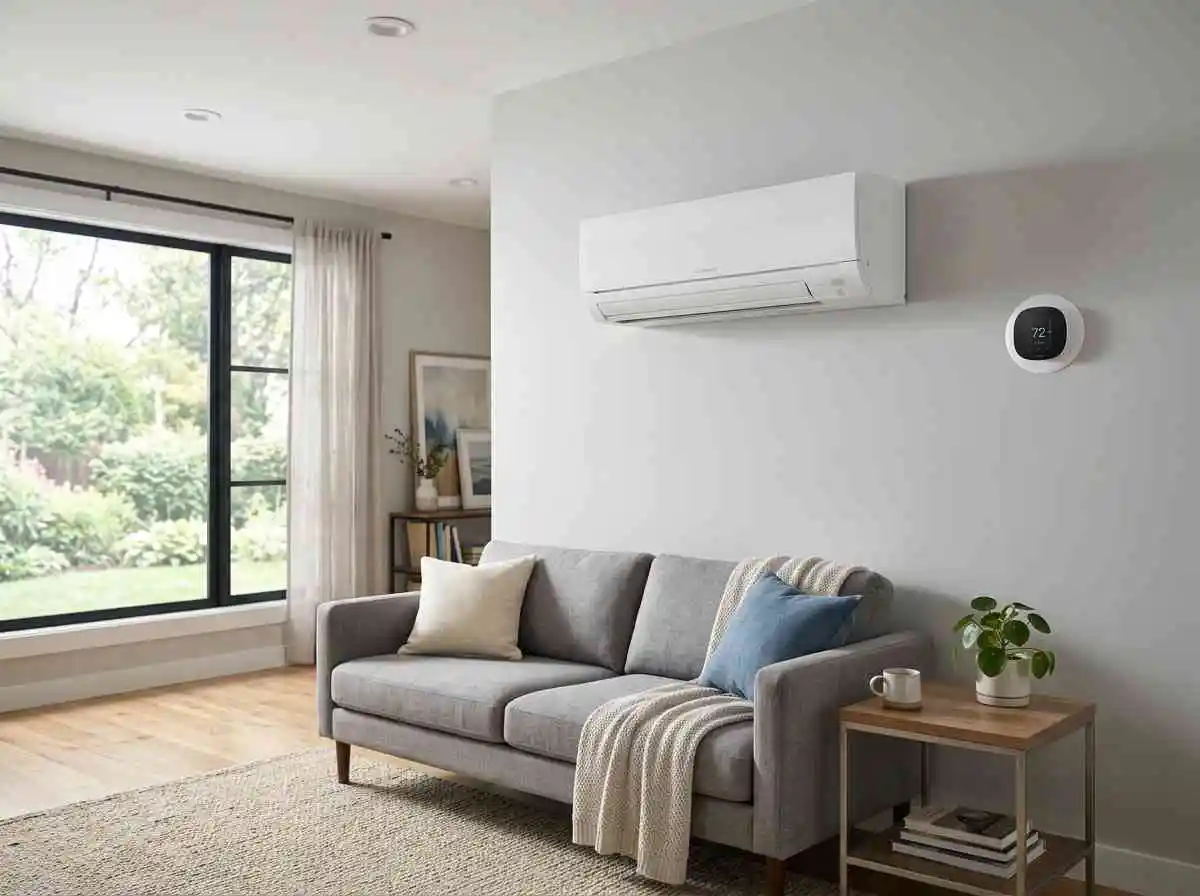
Maintaining indoor climate control during an extended electrical outage is often the deciding factor between comfortably sheltering in place and abandoning a home. However, space cooling and heating represent the single most demanding electrical loads in residential architecture. Running a conventional single-stage central air conditioning system on battery storage frequently proves unviable due to massive steady-state wattage and destructive inductive compressor inrush spikes.
Ductless mini-split heat pumps equipped with electronically commutated, variable-speed DC inverter compressors have emerged as the premier solution for off-grid and battery-backed microgrids. By eliminating thermal distribution duct losses and continuously modulating compressor output down to fractional speeds, mini-splits deliver unmatched SEER2 and HSPF2 efficiency ratings while drawing a fraction of the energy required by central air handlers.
Here is the engineering comparison between variable-speed mini-splits and central AC, the mathematics of inductive startup elimination, and sizing protocols for 48V battery backup integration.
The Architectural Divide: Central AC vs Inverter Mini-Splits
The core differences between conventional central split systems and modern ductless inverter units dictate their operational impact on battery reserves:
| Performance Factor | Conventional Central AC (Single-Stage) | Variable-Speed Mini-Split (DC Inverter) |
|---|---|---|
| Compressor Mechanism | Fixed-speed AC induction motor (On/Off only) | Brushless DC variable-frequency scroll/rotary |
| Starting Inrush Current | Massive (50A to 110A LRA locked rotor spike) | Near Zero (Soft-starts gradually from 1A to 3A) |
| Running Power Draw | 3,000W to 4,500W continuous cycling | 250W to 1,200W dynamically modulated |
| Ductwork Thermal Loss | 15% to 30% conductive/leakage loss in attics | 0% (Ductless direct room thermal delivery) |
| Efficiency Rating | 13 to 15 SEER2 | 20 to 33 SEER2 |
| Battery Impact (15 kWh Bank) | Drains bank in under 3.5 hours | Provides 12 to 24 hours of zoned cooling |
Why Inverter Compressors Eliminate Inrush Surges (Zero LRA Spike)
As documented in our technical analysis on sizing soft starters for central heat pumps, legacy compressors slam across the line with instantaneous Locked Rotor Amps (LRA), pulling up to 25 kW of surge demand that risks tripping off-grid inverters.
Variable-speed mini-splits completely bypass this phenomenon through built-in solid-state power electronics:
- AC to DC Rectification: Incoming 240V AC power from your inverter is rectified into high-voltage direct current within the outdoor condensing unit.
- Pulse-Width Modulation (PWM) Inverter: An intelligent microprocessor converts the DC bus voltage back into variable-frequency AC to drive a brushless permanent-magnet synchronous motor.
- Ramp-Up Profile: Upon calling for cooling, the compressor begins turning at low frequency (under 15 Hz), pulling as little as 1.5 Amps (360 Watts). It gently accelerates over several minutes to match room thermal demand. There is no mechanical jerk and no momentary current surge.
This allows even modest 4,000W to 6,000W hybrid inverters to easily start and run multiple mini-split indoor heads without voltage sags or low-voltage cutouts.
Thermal Modulation: Sizing for Steady-State Turndown
A central AC unit cycles on at 100% capacity until the thermostat is satisfied, shuts off, and then restarts at 100% when the room warms up. This repetitive thermal overshoot wastes enormous energy.
In contrast, an inverter mini-split throttles down to maintain a balanced thermal equilibrium once the room hits setpoint:
Example of Turndown Efficiency:
Consider a high-efficiency 12,000 BTU (1-Ton) 25 SEER2 Mini-Split cooling a primary living space:
- Maximum Pull-Down Capacity: 1,150 Watts (Initial cooling from 85°F down to 72°F).
- Modulated Steady-State Baseline: 280 to 420 Watts (Continuously maintaining 72°F during afternoon heat).
At 350 Watts steady-state, a standard 48V 280Ah LiFePO4 battery bank (storing ~14.3 kWh nominal capacity, calculated per our 48V battery sizing methodology) can power the mini-split for over 30 continuous hours on battery reserves alone, completely independent of daytime solar harvest.
Quick Mini-Split Electrical Sizing Matrix
| Cooling / Heating Capacity | Square Footage Covered | Operating Voltage | Maximum Amps (Breaker MCA) | Steady-State Modulated Watts |
|---|---|---|---|---|
| 9,000 BTU (0.75 Ton) | 250 – 400 sq ft | 115V or 240V | 15A Single-Pole / Double-Pole | 180W – 320W |
| 12,000 BTU (1.0 Ton) | 400 – 650 sq ft | 115V or 240V | 15A to 20A Circuit | 250W – 450W |
| 18,000 BTU (1.5 Ton) | 650 – 1,000 sq ft | 240V Split-Phase | 20A Double-Pole | 450W – 850W |
| 24,000 BTU (2.0 Ton) | 1,000 – 1,400 sq ft | 240V Split-Phase | 25A to 30A Double-Pole | 750W – 1,400W |
System Integration: Critical Subpanels & Load Shedding
When wiring mini-splits into an emergency home power system:
- Zone Optimization: Rather than backing up every room in the house, designate a primary “safe haven” zone (e.g., master bedroom or main living room). Feed only that dedicated mini-split branch circuit into your critical load subpanel audited per our home energy audit and subpanel framework.
- Coexistence with Water Heating: Because a mini-split running at steady-state pulls less than 500W, your inverter can easily support it concurrently with a hybrid heat pump water heater operating in heat-pump-only mode.
- DC Voltage Drop Precautions: Even with low AC draw, verify that your 48V battery conductors and busbars are sized per our DC cable sizing and voltage drop guide to maintain voltage stability.
Summary
For homeowners aiming to achieve continuous off-grid resilience during grid disruptions, replacing or supplementing central air conditioning with an inverter-driven variable-speed mini-split is the single most effective efficiency upgrade available. With near-zero startup surge spikes, 20+ SEER2 efficiency, and sub-400W modulated running draw, ductless mini-splits allow a modest 48V battery storage system to deliver sustained whole-day comfort without risking inverter overload.